


The maintenance calendar says a server can be patched next Thursday. The attacker does not receive that calendar invitation.
This is the timing problem at the center of vulnerability management. Operations teams need bounded change windows, testing, rollback plans, application owners, and staff who can respond if the change fails. Attackers need a reachable weakness, a workable technique, and enough time before defenders remove or isolate it. Those clocks sometimes align. Often they do not.
A monthly patch cycle is an operating rhythm, not a risk decision. Treating it as the answer for every vulnerability makes two opposite errors. It leaves some exposed systems vulnerable too long, and it forces risky emergency changes where other controls could safely create time.
NIST describes enterprise patch management as preventive maintenance that includes identifying, prioritizing, acquiring, installing, and verifying patches, updates, and upgrades. I read the word verifying as part of the process, not an optional report after the ticket closes.
The right question is not simply, "When is the next patch window?" It is, "How long can this specific asset remain in this specific vulnerable state, given what attackers are doing, how the asset is exposed, what the business depends on, what controls are actually enforced, and what risk the change itself introduces?"
Three clocks, not one
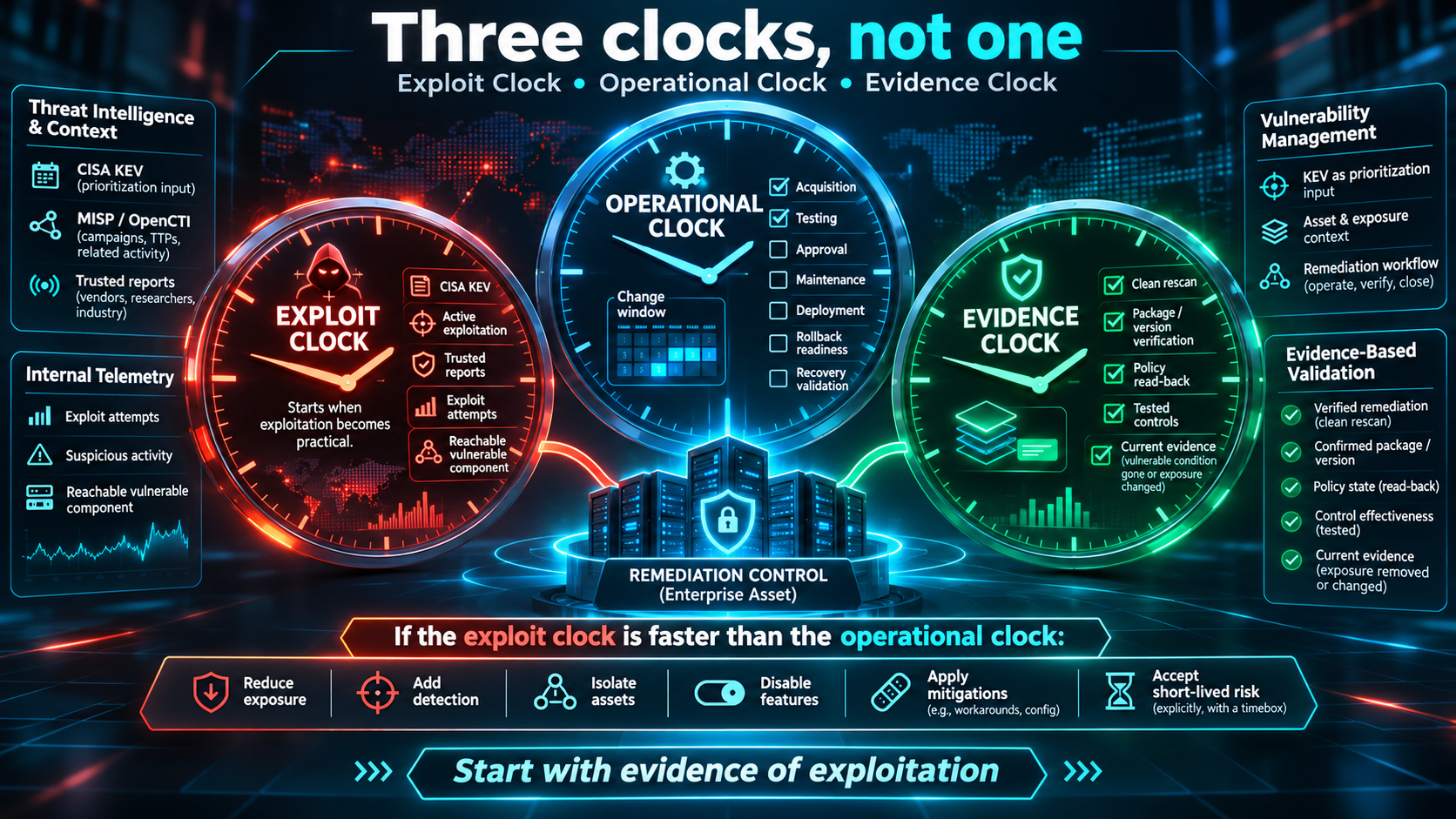
I separate at least three clocks.
The exploit clock
This clock starts when exploitation becomes practical for the threat actors relevant to the environment. That may be before public disclosure, at disclosure, after proof-of-concept publication, or much later. We rarely know the exact start. We can still observe evidence that the clock is moving.
CISA maintains the Known Exploited Vulnerabilities catalog as an authoritative list of vulnerabilities known to have been exploited in the wild and recommends using it as an input to prioritization. Inclusion is strong evidence that exploitation is no longer hypothetical. CISA's current Binding Operational Directive 26-04 requires covered Federal Civilian Executive Branch agencies to remediate listed vulnerabilities according to the directive's timelines, and CISA recommends that other organizations use the catalog to prioritize remediation.
The operational clock
This clock covers acquisition, testing, approval, maintenance, deployment, rollback readiness, and recovery validation. Its duration depends on architecture and operational maturity. A stateless web node behind a load balancer may be replaceable in minutes. A fragile industrial controller, storage array, or revenue system may need vendor coordination and an outage plan.
The evidence clock
This clock starts when a change is claimed and stops when current evidence shows the vulnerable condition is gone or its exposure has changed. A completed deployment job is not the same as a clean rescan. A package version on one cluster node is not proof for every node. A firewall request is not a compensating control until the enforced path is read back and tested.
The remediation program has to reconcile all three. If the exploit clock is faster than the operational clock, I do not wait passively. I reduce exposure, add detection, isolate the asset, disable the feature, apply a vendor mitigation, or accept the risk explicitly with a short expiration.
Start with evidence of exploitation
CVSS is useful for describing technical severity. It does not tell me whether exploitation is happening now, whether the vulnerable path is reachable in my environment, or whether the asset carries a critical business process.
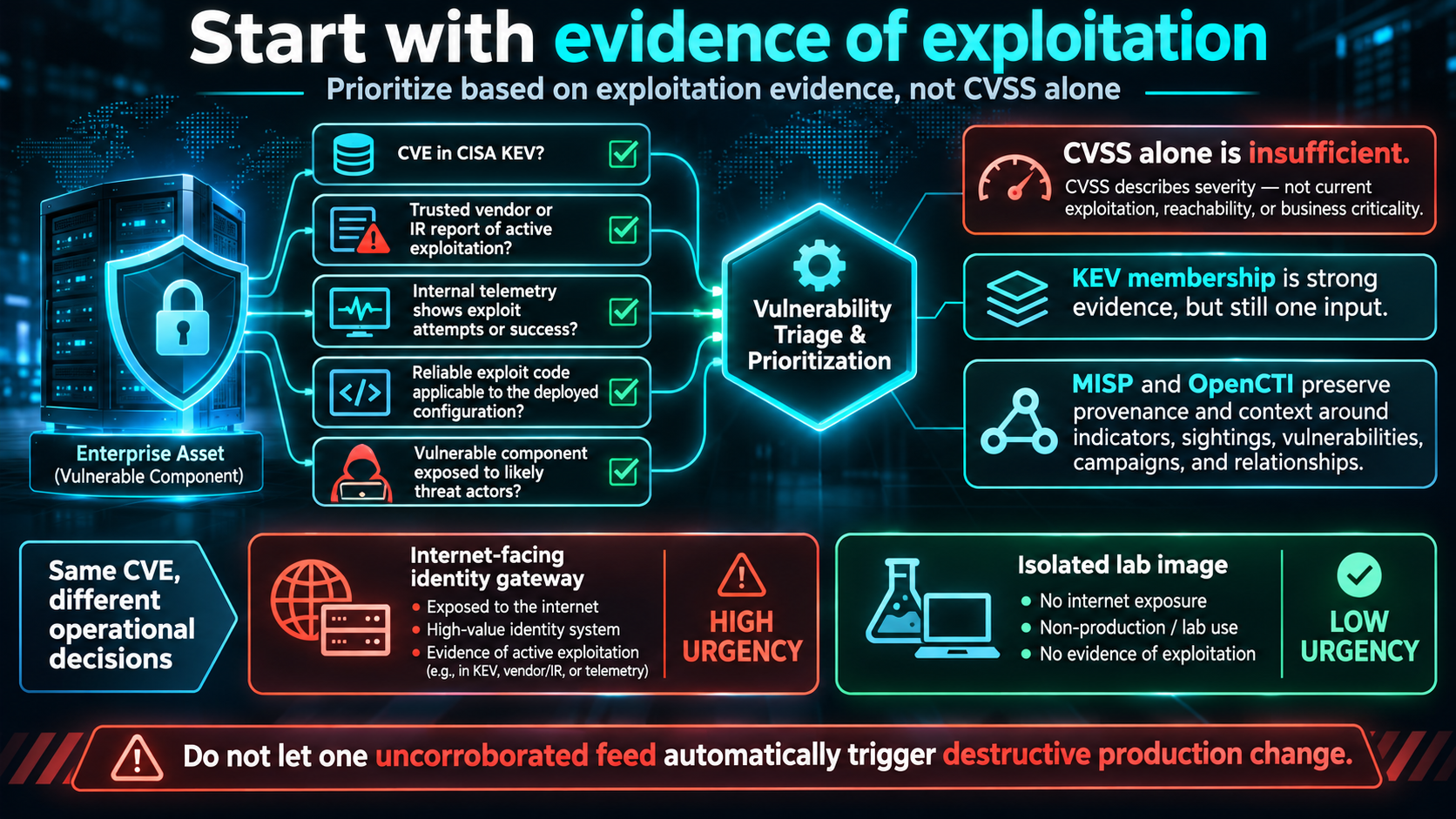
My first prioritization gate asks about exploitation evidence:
- Is the CVE in CISA KEV?
- Has a trusted vendor or incident-response source reported active exploitation?
- Has internal telemetry shown exploit attempts or successful behavior?
- Is reliable exploit code available and applicable to the deployed configuration?
- Is the vulnerable component exposed to likely threat actors?
KEV membership gets a clear escalation path. It is binary evidence with a documented basis, but it is still an input. An internet-facing KEV on an identity gateway and the same CVE on an isolated lab image do not create identical operational decisions.
Threat-intelligence platforms help maintain the surrounding evidence. MISP can distribute indicators, sightings, vulnerability references, and contextual attributes among trusted communities. OpenCTI can model vulnerabilities alongside threat actors, campaigns, malware, infrastructure, reports, and relationships. I use those systems to preserve provenance and context. I do not let a single uncorroborated feed automatically launch a destructive production change.
Use EPSS as one signal
The Exploit Prediction Scoring System estimates the probability that exploitation activity for a published CVE will be observed in the next 30 days. FIRST is explicit that EPSS is not a severity score and not a complete risk score.
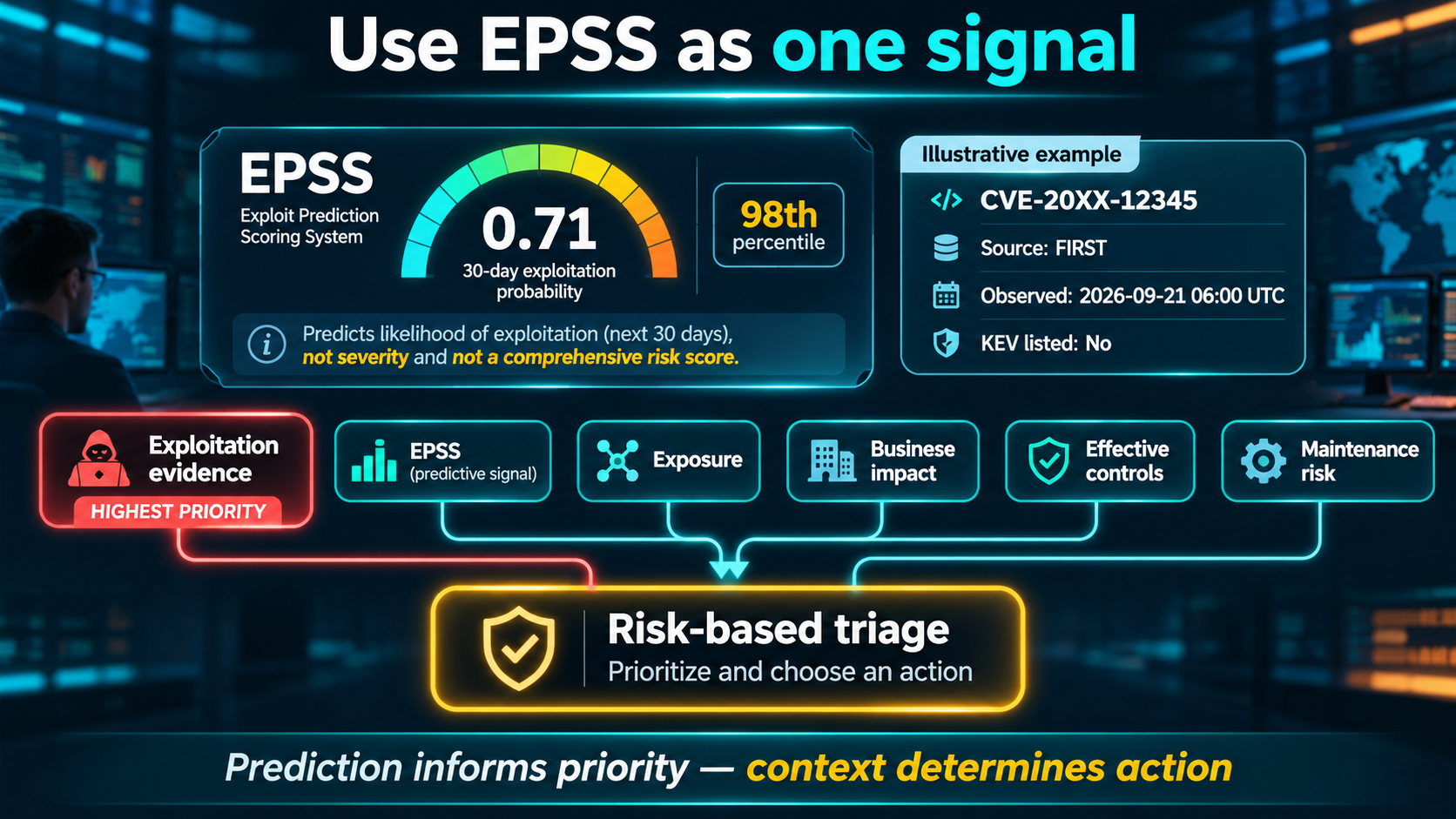
That makes EPSS useful and easy to misuse.
A high EPSS score can raise urgency for a remotely reachable vulnerability that has not yet entered KEV. A low score can help order a large backlog after stronger gates have been considered. It should not overrule direct internal exploitation evidence, erase business impact, or justify ignoring an exposed control-plane vulnerability.
I store the score with its retrieval time because it changes:
{
  "cve": "CVE-20XX-12345",
  "epss": {
    "probability": 0.71,
    "percentile": 0.98,
    "observed_at": "2026-09-21T06:00:00Z",
    "source": "FIRST"
  },
  "kev": {
    "listed": false,
    "observed_at": "2026-09-21T06:00:00Z"
  }
}
I never write a policy that says "patch every EPSS score above 0.5 within 24 hours" without additional context. The threshold may be useful as a queue trigger. The actual action depends on exposure, impact, controls, and maintenance risk.
Exposure changes the deadline
"Internet-facing" is an important label, but it is not enough. I want to know whether the vulnerable function is reachable from the attacker's position.
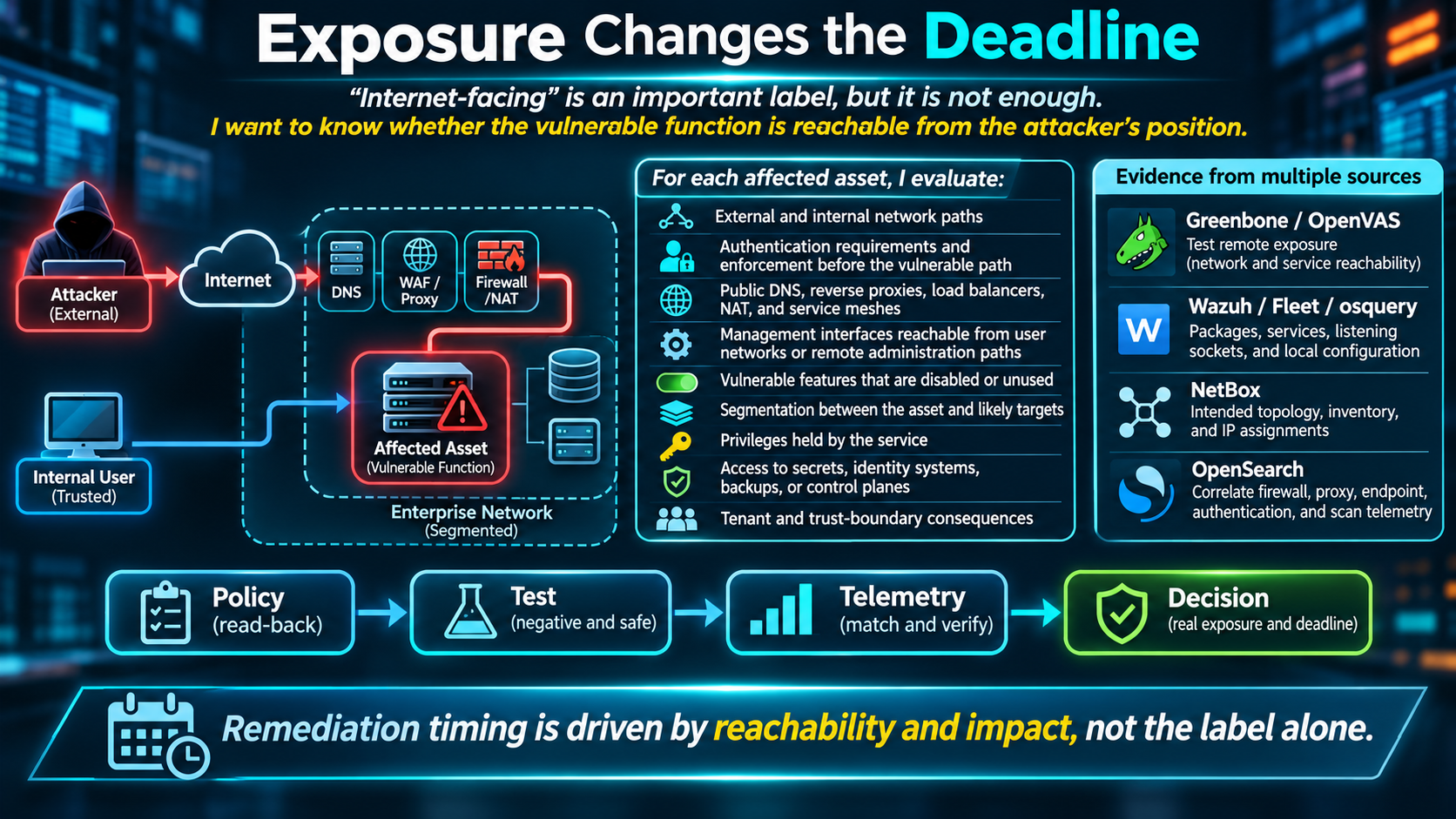
For each affected asset, I evaluate:
- external and internal network paths
- authentication requirements and whether they are enforced before the vulnerable code path
- public DNS, reverse proxies, load balancers, NAT, and service meshes
- management interfaces reachable from user networks or remote administration paths
- vulnerable features that are disabled or unused
- segmentation between the asset and likely targets
- privileges held by the service
- access to secrets, identity systems, backups, or control planes
- tenant and trust-boundary consequences
A network scanner such as Greenbone/OpenVAS can test remote exposure. Wazuh, Fleet, or osquery can show packages, services, listening sockets, and local configuration. NetBox can supply intended topology and IP assignments. OpenSearch can correlate firewall, proxy, endpoint, authentication, and scan telemetry. Each source answers a different question.
I do not infer a working compensating control from a diagram. If a firewall is supposed to block the path, I need policy read-back and a negative test from the relevant source zone. If a web application firewall is supposed to block an exploit pattern, I need a safe test, matched telemetry, and awareness of bypass conditions. If an agent is supposed to detect exploitation, I need an exercised detection path and an owned response.
Business criticality cuts both ways
Critical systems deserve faster risk reduction because compromise can cause greater harm. They may also demand more careful changes because a failed patch can create immediate operational harm.
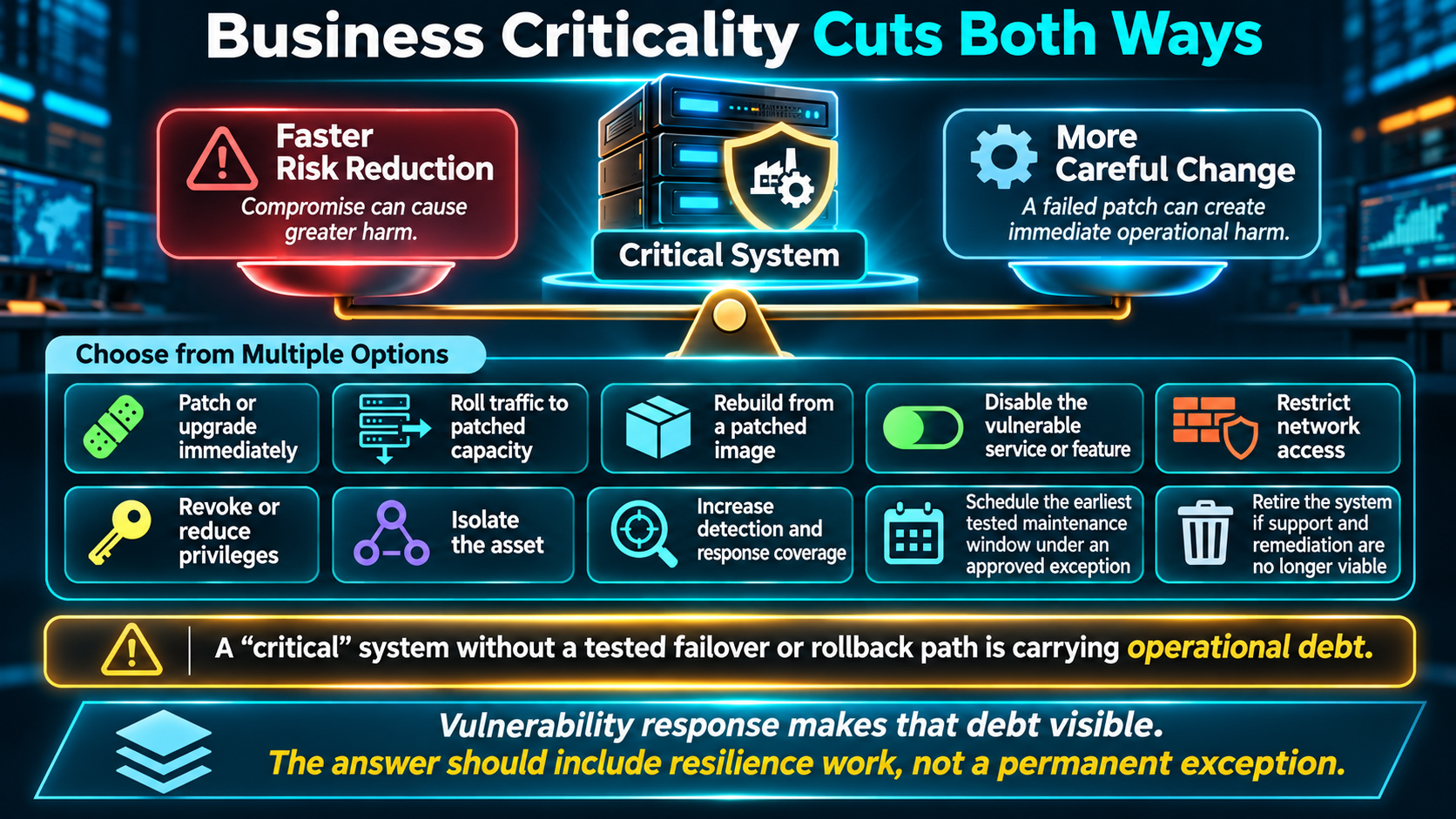
That is not a reason to leave them exposed. It is a reason to choose among more options:
- patch or upgrade immediately
- roll traffic to patched capacity
- rebuild from a patched image
- disable the vulnerable service or feature
- restrict network access
- revoke or reduce privileges
- isolate the asset
- increase detection and response coverage
- schedule the earliest tested maintenance window under an approved exception
- retire the system if support and remediation are no longer viable
A system labeled "critical" but lacking a tested failover or rollback path is carrying operational debt. Vulnerability response makes that debt visible. The answer should include resilience work, not a permanent exception.
Use a decision matrix, then preserve judgment
A matrix creates a common starting point without pretending risk is a single universal score.
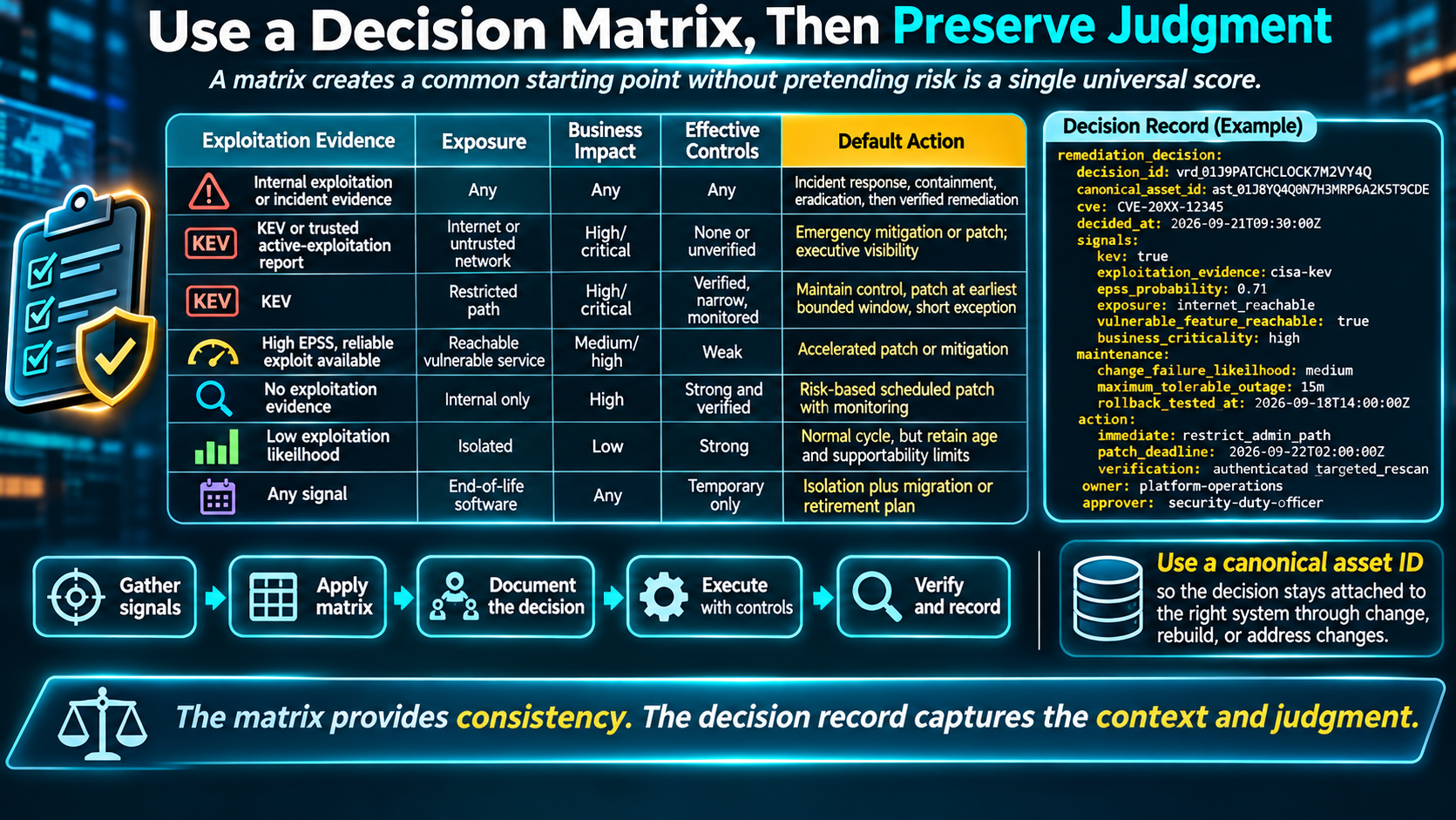
| Exploitation evidence | Exposure | Business impact | Effective controls | Default action |
|---|---|---|---|---|
| Internal exploitation or incident evidence | Any | Any | Any | Incident response, containment, eradication, then verified remediation |
| KEV or trusted active-exploitation report | Internet or untrusted network | High/critical | None or unverified | Emergency mitigation or patch; executive visibility |
| KEV | Restricted path | High/critical | Verified, narrow, monitored | Maintain control, patch at earliest bounded window, short exception |
| High EPSS, reliable exploit available | Reachable vulnerable service | Medium/high | Weak | Accelerated patch or mitigation |
| No exploitation evidence | Internal only | High | Strong and verified | Risk-based scheduled patch with monitoring |
| Low exploitation likelihood | Isolated | Low | Strong | Normal cycle, but retain age and supportability limits |
| Any signal | End-of-life software | Any | Temporary only | Isolation plus migration or retirement plan |
CISA's Stakeholder-Specific Vulnerability Categorization work offers a decision-oriented approach that considers exploitation and technical impact rather than relying only on a base severity score. I use a local matrix for consistency, then require the decision record to explain facts that the table cannot capture.
A machine-readable record might be:
remediation_decision:
  decision_id: vrd_01J9PATCHCLOCK7M2VY4Q
  canonical_asset_id: ast_01J8YQ4Q0N7H3MRP6A2K5T9CDE
  cve: CVE-20XX-12345
  decided_at: 2026-09-21T09:30:00Z
  signals:
    kev: true
    exploitation_evidence: cisa-kev
    epss_probability: 0.71
    exposure: internet_reachable
    vulnerable_feature_reachable: true
    business_criticality: high
  maintenance:
    change_failure_likelihood: medium
    maximum_tolerable_outage: 15m
    rollback_tested_at: 2026-09-18T14:00:00Z
  action:
    immediate: restrict_admin_path
    patch_deadline: 2026-09-22T02:00:00Z
    verification: authenticated_targeted_rescan
  owner: platform-operations
  approver: security-duty-officer
The canonical asset ID matters. Without it, the timing decision can be attached to a hostname that is rebuilt or an IP address that moves before verification.
Account for maintenance risk explicitly
Emergency patching can cause outages, data corruption, incompatibility, and failed recovery. Pretending otherwise produces shadow delay, where teams quietly wait while the dashboard claims urgency.
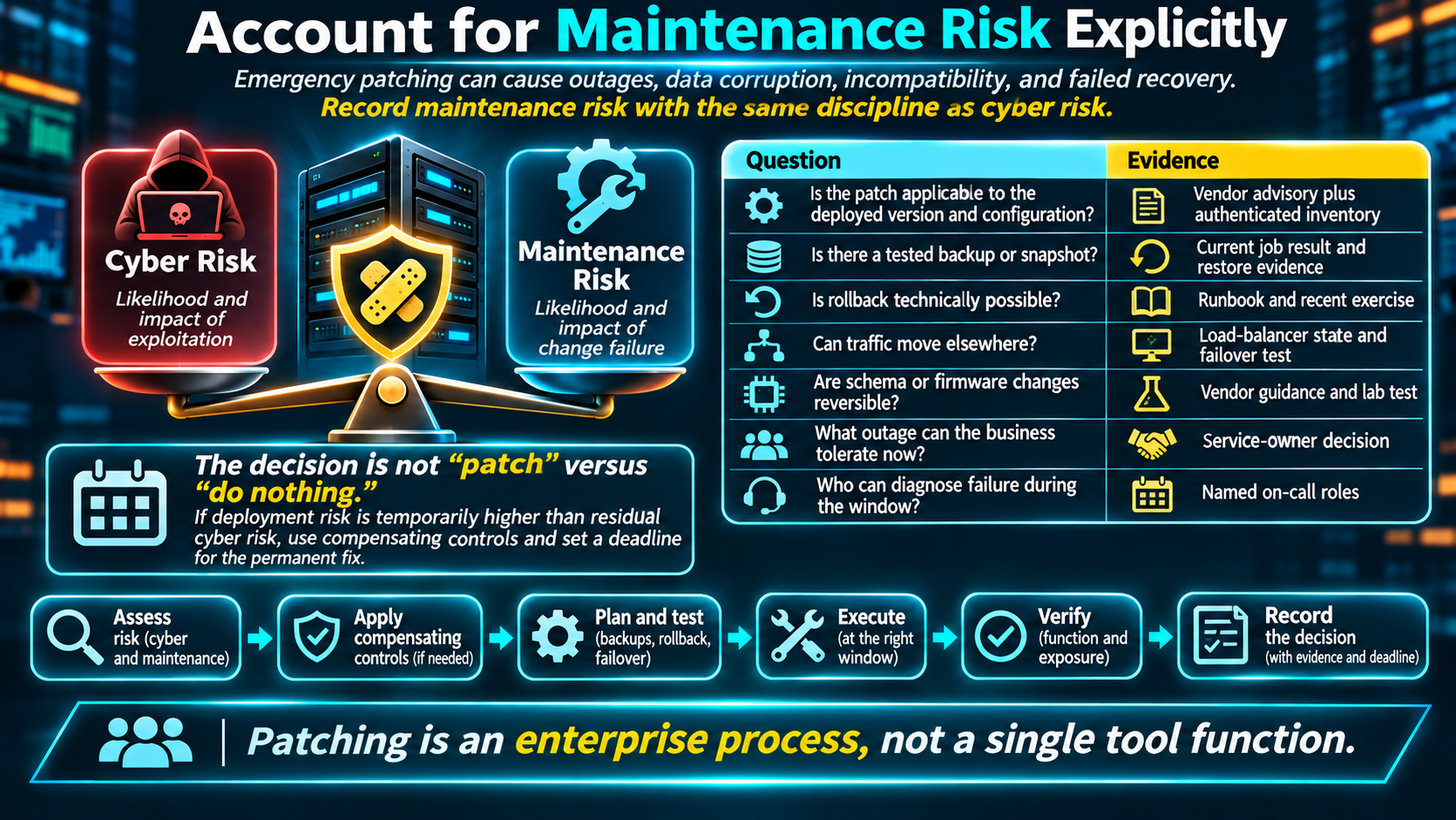
I record maintenance risk with the same discipline as cyber risk:
| Question | Evidence |
|---|---|
| Is the patch applicable to the deployed version and configuration? | Vendor advisory plus authenticated inventory |
| Is there a tested backup or snapshot? | Current job result and restore evidence |
| Is rollback technically possible? | Runbook and recent exercise |
| Can traffic move elsewhere? | Load-balancer state and failover test |
| Are schema or firmware changes reversible? | Vendor guidance and lab test |
| What outage can the business tolerate now? | Service-owner decision |
| Who can diagnose failure during the window? | Named on-call roles |
The output is not "patch" versus "do nothing." If deployment risk is temporarily higher than residual cyber risk, compensating controls must narrow the vulnerable interval. The decision also needs a deadline for the permanent fix.
NIST frames patch management as an enterprise process rather than a tool function. That is useful because operations, service ownership, security, architecture, and leadership each own part of the decision. The scanner cannot negotiate downtime. The business owner cannot determine exploitability alone. Security cannot claim a firewall mitigates the issue without network evidence.
Compensating controls must be specific and testable
A compensating control is not the sentence "segmentation is in place."
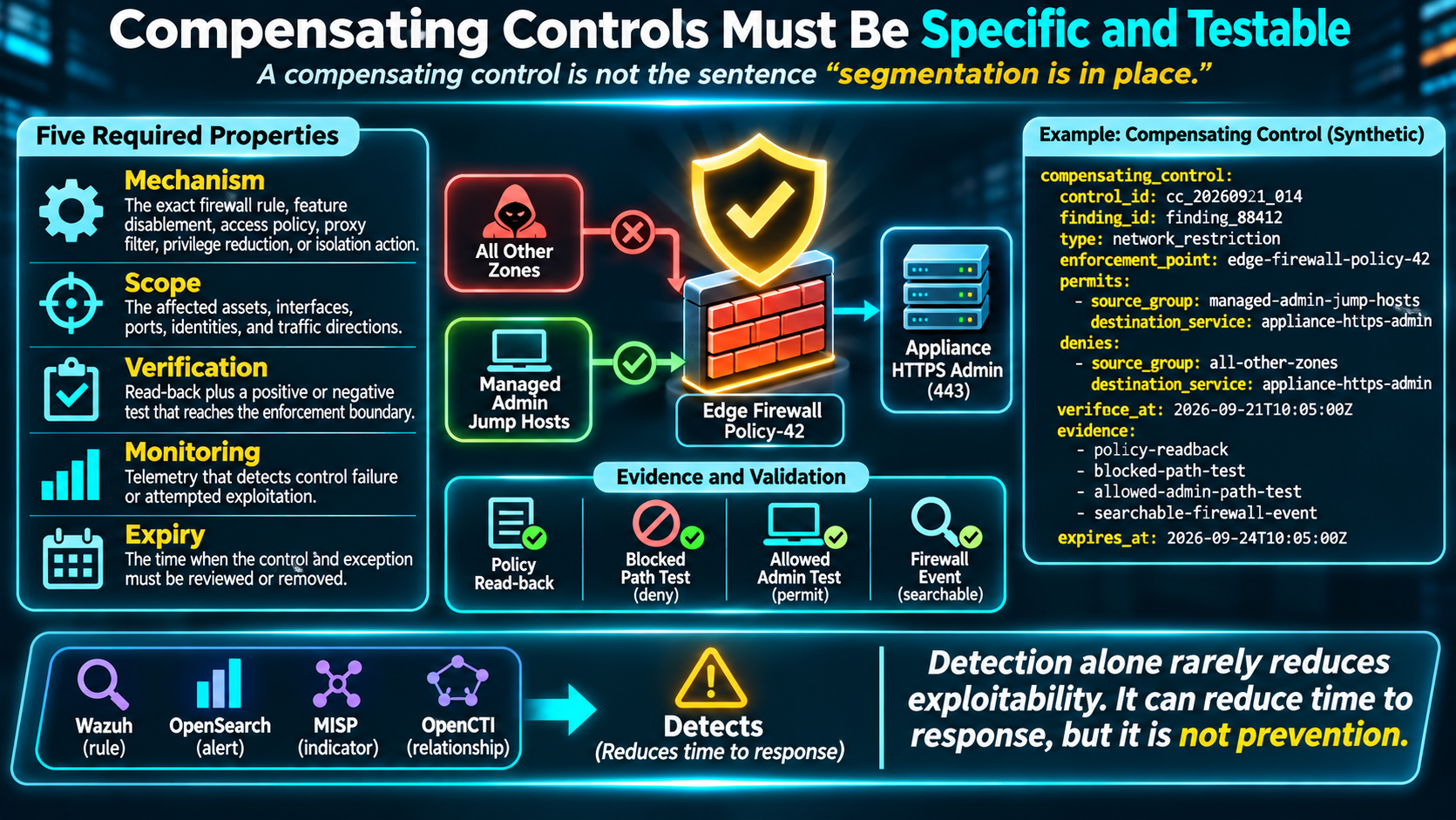
I require five properties:
- Mechanism: the exact firewall rule, feature disablement, access policy, proxy filter, privilege reduction, or isolation action.
- Scope: the affected assets, interfaces, ports, identities, and traffic directions.
- Verification: read-back plus a positive or negative test that reaches the enforcement boundary.
- Monitoring: telemetry that detects control failure or attempted exploitation.
- Expiry: the time when the control and exception must be reviewed or removed.
For example:
# All identifiers and timestamps in this example are synthetic.
compensating_control:
  control_id: cc_20260921_014
  finding_id: finding_88412
  type: network_restriction
  enforcement_point: edge-firewall-policy-42
  permits:
    - source_group: managed-admin-jump-hosts
      destination_service: appliance-https-admin
  denies:
    - source_group: all-other-zones
      destination_service: appliance-https-admin
  verified_at: 2026-09-21T10:05:00Z
  evidence:
    - policy-readback
    - blocked-path-test
    - allowed-admin-path-test
    - searchable-firewall-event
  expires_at: 2026-09-24T10:05:00Z
Detection alone rarely reduces exploitability. It can reduce time to response, which may be valuable, but I label it honestly. A Wazuh rule, OpenSearch alert, MISP indicator match, or OpenCTI relationship does not prevent exploitation unless it drives an effective preventive or containment action.
Exceptions are expiring risk decisions
An exception should never be a comment that says, "Vendor will patch later."
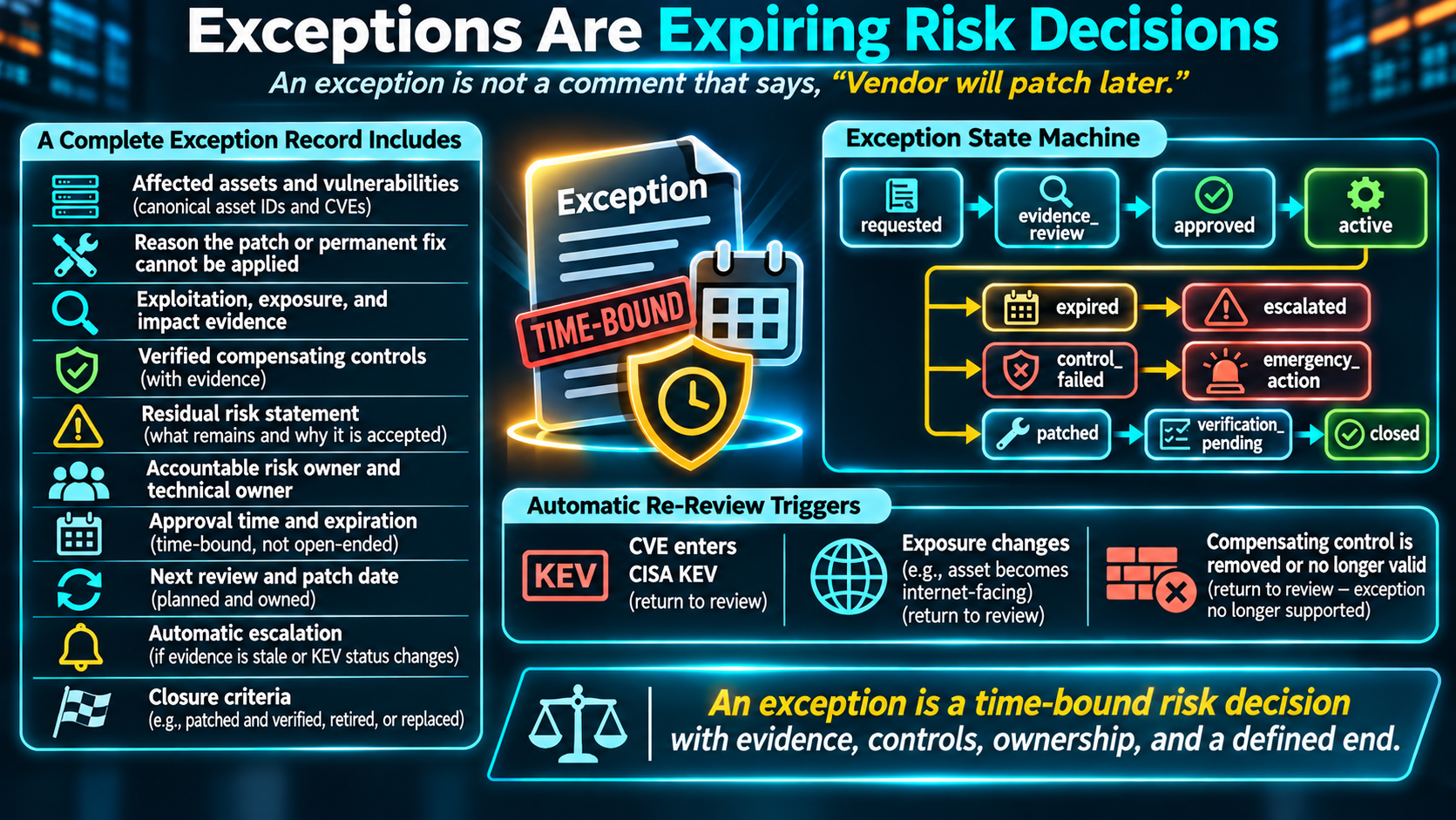
I require:
- affected canonical assets and vulnerabilities
- reason the patch or permanent fix cannot be applied
- exploitation, exposure, and impact evidence
- verified compensating controls
- residual risk statement
- accountable risk owner and technical owner
- approval time and expiration
- next review and patch date
- automatic escalation if evidence becomes stale or KEV status changes
- closure criteria
A useful exception state machine is:
requested -> evidence_review -> approved -> active
active -> expired -> escalated
active -> control_failed -> emergency_action
active -> patched -> verification_pending -> closed
If a CVE enters KEV during an active exception, the record should return to review automatically. If the asset becomes internet-facing, the same should happen. If the compensating firewall rule disappears, the exception is no longer supported by its original facts.
Verified rescans stop the evidence clock
The final weakness in many patch programs is closure by assertion.
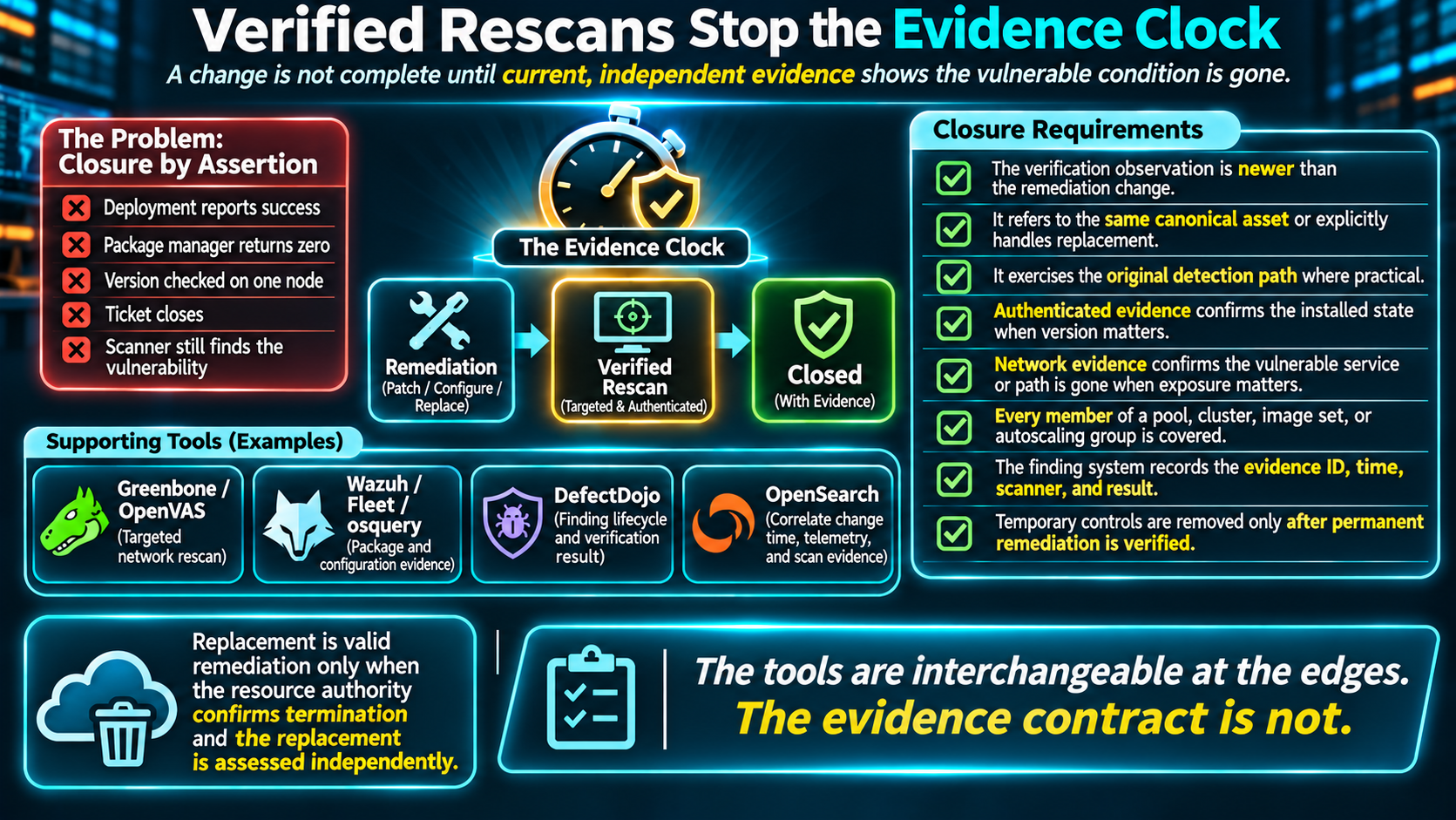
A deployment platform reports success. A package manager returns zero. An administrator checks the version on one node. The ticket closes. The scanner still sees the vulnerable service on an overlooked interface, an unpatched cluster member, or a host that never rebooted into the new kernel.
My closure requirements are simple:
- The verification observation is newer than the remediation change.
- It refers to the same canonical asset or explicitly handles replacement.
- It exercises the original detection path where practical.
- Authenticated evidence confirms the installed state when version matters.
- Network evidence confirms the vulnerable service or path is gone when exposure matters.
- Every member of a pool, cluster, image set, or autoscaling group is covered.
- The finding system records the evidence ID, time, scanner, and result.
- Temporary controls are removed only after permanent remediation is verified.
Greenbone/OpenVAS can provide a targeted network rescan. Wazuh, Fleet, or osquery can refresh package and configuration evidence. DefectDojo can retain the finding lifecycle and import the verification result. OpenSearch can correlate change time, telemetry, and scan evidence. The tools are interchangeable at the edges. The evidence contract is not.
Destroying a vulnerable cloud instance can be valid remediation, but only when the resource authority confirms termination and the replacement is assessed independently. A stale agent record or recycled address must not cause the old finding to close against the wrong machine.
Test the decision system
A prioritization policy needs tests just as automation does.
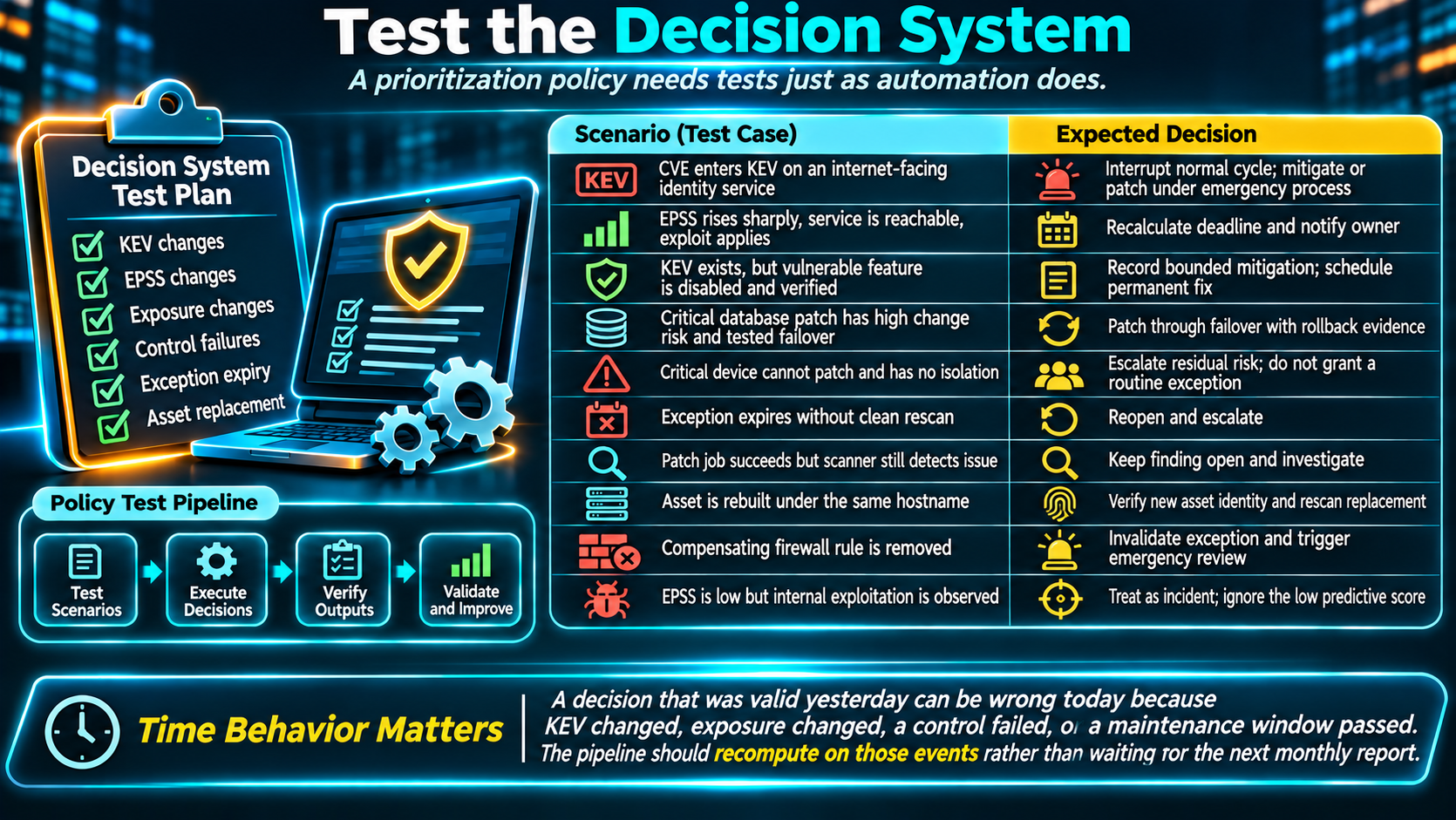
| Scenario | Expected decision |
|---|---|
| CVE enters KEV on an internet-facing identity service | Interrupt normal cycle; mitigate or patch under emergency process |
| EPSS rises sharply, service is reachable, exploit applies | Recalculate deadline and notify owner |
| KEV exists, but vulnerable feature is disabled and verified | Record bounded mitigation; schedule permanent fix |
| Critical database patch has high change risk and tested failover | Patch through failover with rollback evidence |
| Critical device cannot patch and has no isolation | Escalate residual risk; do not grant a routine exception |
| Exception expires without clean rescan | Reopen and escalate |
| Patch job succeeds but scanner still detects issue | Keep finding open and investigate |
| Asset is rebuilt under the same hostname | Verify new asset identity and rescan replacement |
| Compensating firewall rule is removed | Invalidate exception and trigger emergency review |
| EPSS is low but internal exploitation is observed | Treat as incident; ignore the low predictive score |
I also test time behavior. A decision that was valid yesterday may be wrong today because KEV changed, exposure changed, a control failed, or a maintenance window passed. The pipeline should recompute on those events rather than waiting for the next monthly report.
Measure the vulnerable interval honestly
Patch compliance is still useful, but it is not enough. I track:
- time from exploitation evidence to decision
- time from decision to verified mitigation
- time from decision to verified permanent remediation
- KEV findings past the local deadline
- exceptions with stale evidence or expired controls
- findings closed without a newer rescan
- vulnerable internet-exposed assets by business criticality
- remediation failures and rollback frequency
- systems whose architecture prevents safe rapid patching
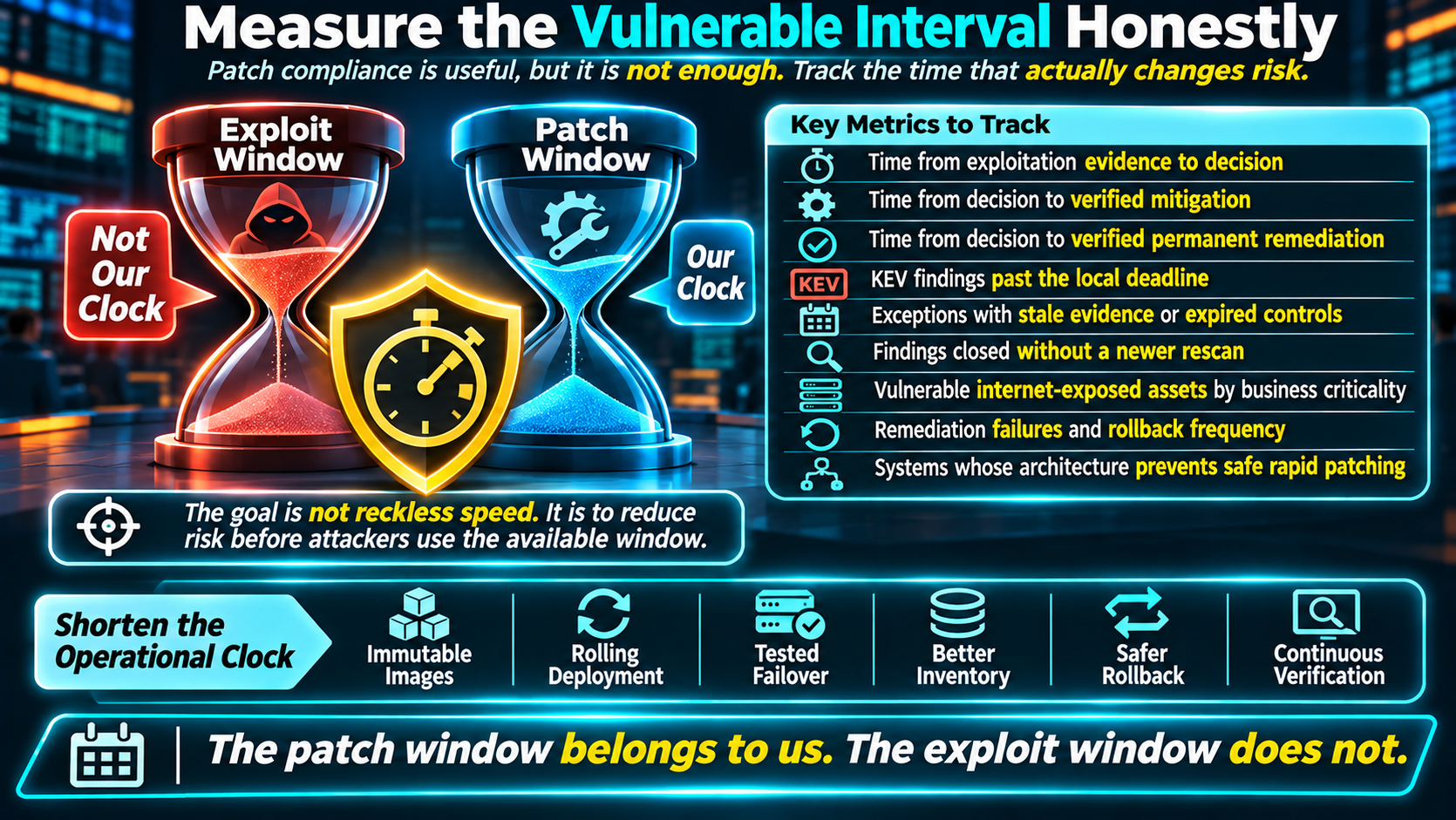
Those metrics show whether the organization can reduce risk before attackers use the available window. They also reveal where platform engineering can help: immutable images, rolling deployment, tested failover, better inventory, safer rollback, and continuous verification all shorten the operational clock.
The goal is not reckless speed. It is to stop confusing a convenient calendar with the time available to defend a system. Exploitation evidence sets urgency. Exposure and business impact shape consequence. Compensating controls can buy bounded time. Maintenance risk determines how to change safely. Exceptions make residual risk explicit. A verified rescan proves when the vulnerable state actually ended.
The patch window belongs to us. The exploit window does not.


