


The term "AI guardrail" is often reduced to a system prompt, a content filter, or a list of topics the model should refuse. Those measures can influence model behavior. They do not establish who is accountable, which data the system may use, what tools it may call, which actions require approval, or how anyone will prove that an action succeeded.
A discussion with Rich from 2GuysTek made me realize that people may not have a clear or consistent understanding of what I mean when I refer to AI guardrails. Some may think only of model refusals or content moderation. In this article, I use the term to mean the complete set of policy, technical, and operational controls that keeps an AI system within its authorized purpose and makes its decisions and actions accountable, bounded, and verifiable.

A credible guardrail program has to govern the complete system around the model.
That includes the application, identities, data stores, retrieval sources, tool brokers, network paths, approval services, logs, monitoring, and people who own the outcome. Some controls may be expressed as instructions to a model. The controls that protect consequential actions need enforcement outside the model.
The following baseline is intended as a minimum. It should be adapted to the organization's use cases, risk tolerance, legal obligations, data classifications, and operating environment. A public writing assistant and an agent that can modify production infrastructure do not need the same approval path, but neither should operate without a defined one.
The minimum operating principle is:
An AI system must not claim authority it does not have, access information it does not need, take consequential action without appropriate control, or report a result it has not verified.
Everything else in the baseline supports that principle.
Start with authority and accountability
The first guardrail is scope. An AI system needs an approved purpose, environment, data boundary, permission set, and set of expected outcomes. It must not expand any of them on its own.
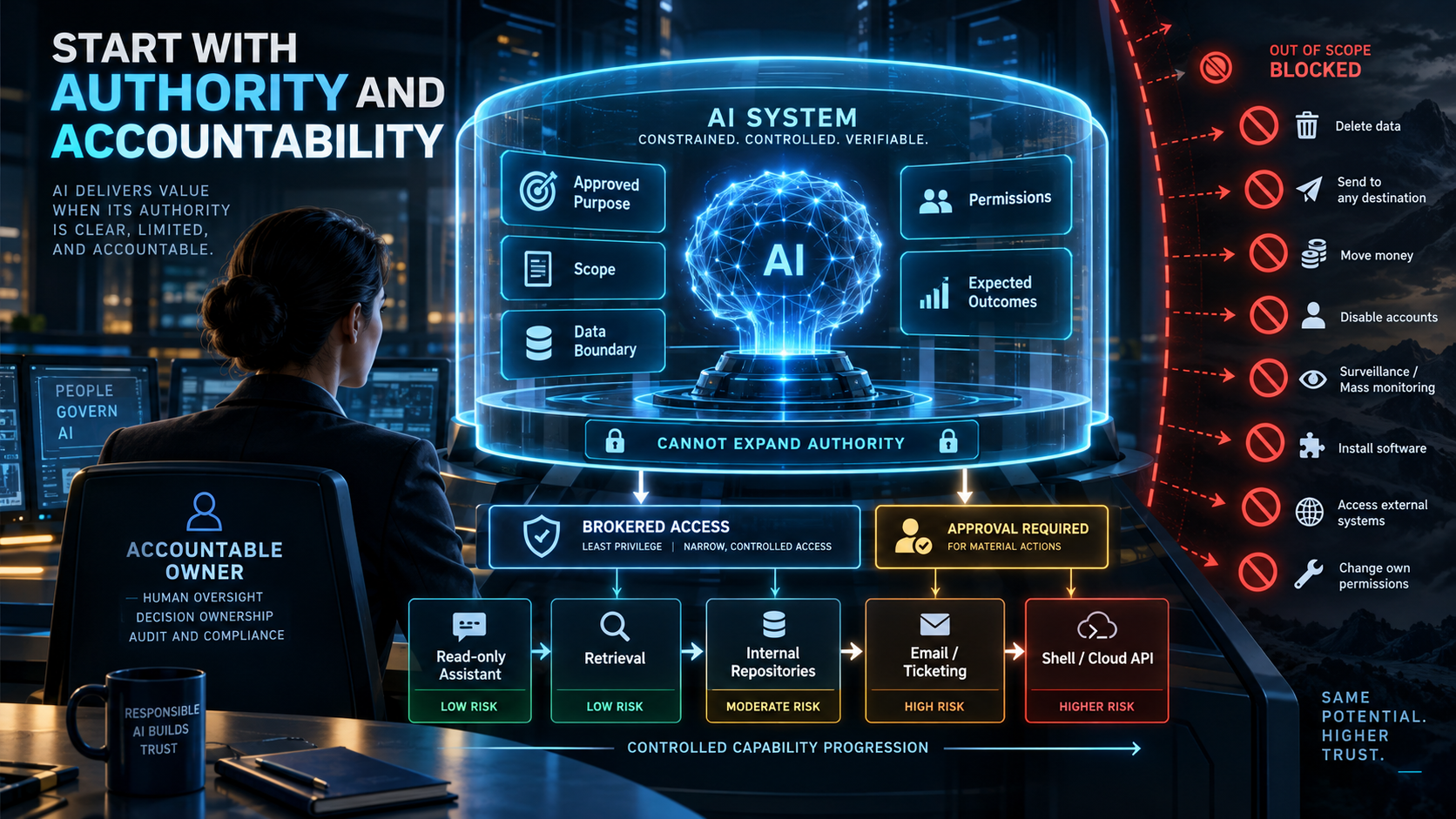
This matters because AI applications tend to accumulate capability. A read-only assistant gains document retrieval. Retrieval becomes access to internal repositories. Then someone adds email, ticketing, a shell, or a cloud API because the assistant would be more useful if it could "finish the task." Each addition changes the risk even when the model stays the same.
An inventory should therefore describe more than the model and provider. For each AI system, record:
- the business purpose and accountable owner
- the users, environments, and data classifications in scope
- the models, retrieval sources, tools, and external services it can reach
- the actions it may propose and the actions it may execute
- the human approvals required for material consequences
- the conditions that cause the system to stop or enter a degraded mode
- the records needed to reconstruct a decision or action
Accountability remains with a person or organizational role. The model can support a decision, rank options, draft content, identify patterns, or recommend a response. It cannot accept legal, operational, or ethical responsibility for the result.
Human oversight should be based on consequence rather than novelty. An AI-assisted spelling correction does not need the same review as a decision affecting employment, access, money, privacy, production availability, legal rights, or public reputation. Higher-risk use cases need stronger approval, better evidence, tighter permissions, and a clear appeal or override path.
Least privilege turns that governance decision into a technical boundary. Give the system only the data, tools, network access, execution rights, and duration needed for the approved task. A model should not receive a reusable administrator credential because one possible workflow might eventually need it. Use a broker, a narrow operation, a short-lived identity, and approval tied to the exact action.
Safety belongs in the same authority model. A rule that says "do not cause harm" is useful guidance, but it is not enough when the runtime can delete data, contact arbitrary destinations, move money, disable accounts, or operate surveillance functions. Unsafe and unauthorized effects should be impossible or independently denied, even if the model requests them.
Protect data and preserve trust boundaries
AI systems combine content from users, documents, websites, email, APIs, databases, tools, and prior conversations. That mixture creates a trust-boundary problem.
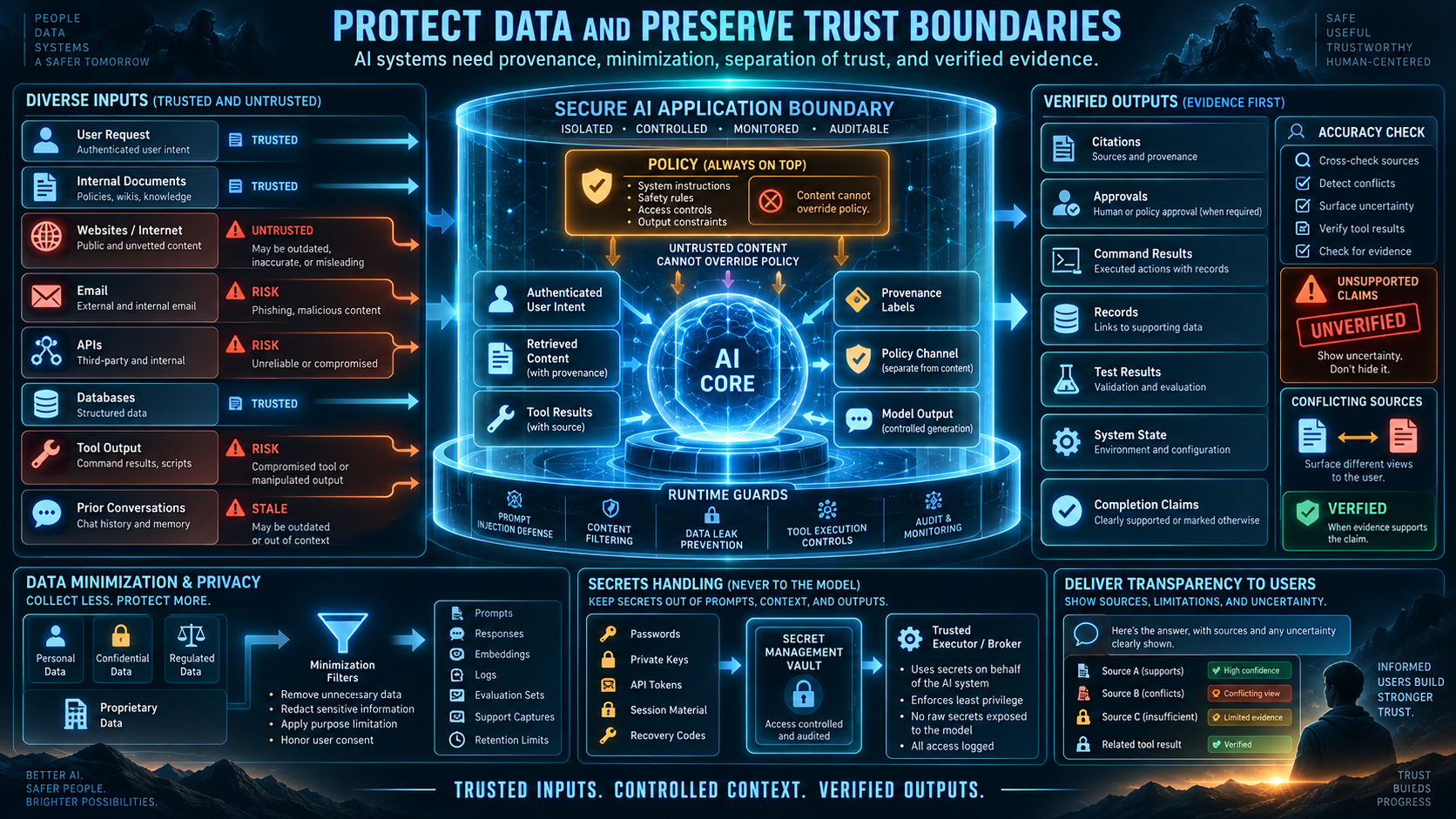
External content may be accurate, malicious, stale, poisoned, incorrectly classified, or written to manipulate the model. Tool output can also be untrusted. A compromised service can return an instruction just as easily as a web page can. Retrieval does not make content authoritative, and placement inside a context window does not turn data into policy.
The application should preserve the source and permitted use of each input. System policy, authenticated user intent, retrieved material, model output, and tool results are different classes of information. Embedded instructions from an untrusted source must not override system policy, authorization boundaries, or the user's legitimate request.
Privacy controls also need to exist before the prompt is assembled. Personal, confidential, regulated, and proprietary data should be admitted only for an authorized purpose. Minimize the fields, records, and history provided to the model. Apply retention limits to prompts, responses, embeddings, logs, evaluation sets, and support captures. Confirm what external providers retain, where they process it, and whether they use it for training.
Secrets require stricter handling. Passwords, private keys, session material, API tokens, and recovery codes do not belong in model context, source code, ordinary logs, or training data. Keep them in an approved secret-management system. When a tool needs a credential, a trusted executor should use it without returning the value to the model.
Accuracy is another trust boundary. Generated, inferred, and retrieved information should not be presented as established fact unless the system has enough evidence to support that claim. Material assumptions, uncertainty, missing information, and conflicting sources should be visible to the user.
The system must never fill an evidence gap with plausible output. Citations, approvals, command results, records, test results, system state, and completion claims must be real. If a result cannot be verified, the correct status is "unverified," not a confident reconstruction of what probably happened.
Put controls around action, not only content
The risk changes when model output becomes an external effect.
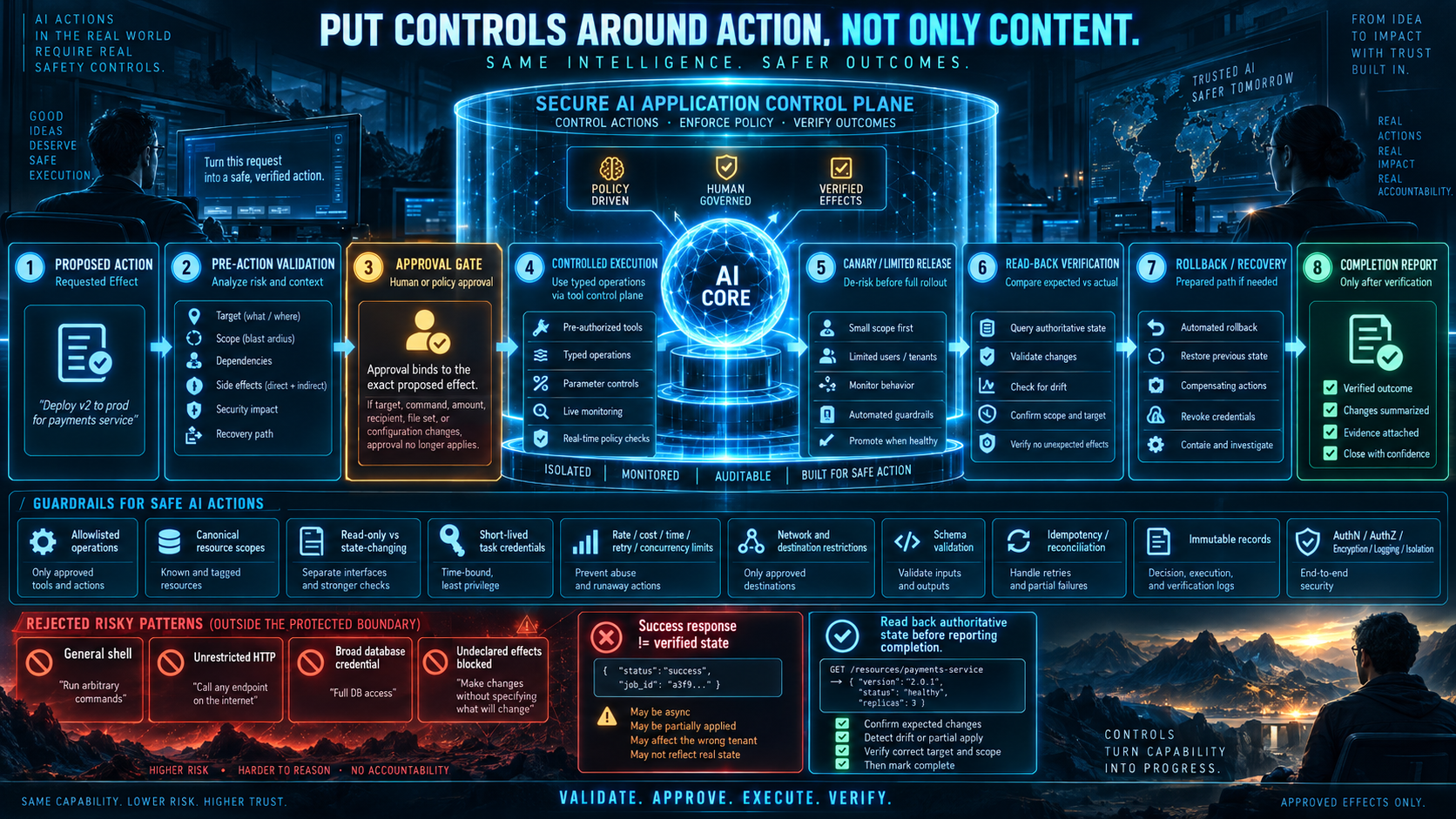
Before a consequential action, the system should validate the target, scope, dependencies, expected side effects, security impact, and recovery path. The approval decision should bind to the exact proposed effect. If the target, command, amount, recipient, file set, or configuration changes, the approval no longer applies.
Destructive, irreversible, externally visible, and high-impact operations require explicit authorization. Changes should be bounded, tested, and reversible where possible. Broad deployment should follow a successful canary or other limited release. Recovery and rollback need to be designed before execution, not after the first failure.
Post-action validation closes a common gap. A successful API response proves that a request received a successful response. It does not prove that the intended state now exists. An asynchronous job may still be running. A batch may have partially applied. The wrong tenant or resource may have been changed. The system should read back the authoritative state and compare the observed result with the approved proposal before reporting completion.
Tool-enabled AI needs a dedicated control plane. Sensitive tools should enforce:
- allowlisted operations and canonical resource scopes
- separate read-only and state-changing interfaces
- short-lived, task-specific credentials
- approval gates for consequential effects
- rate, cost, time, retry, concurrency, and resource limits
- network and destination restrictions
- schema validation and safe output handling
- idempotency or reconciliation for uncertain writes
- immutable decision, execution, and verification records
A general shell, unrestricted HTTP client, or broad database credential makes the prompt part of the security perimeter. Prefer typed operations that expose the business action the system needs and reject undeclared effects.
Secure design still applies to the surrounding application. Strong authentication, server-side authorization, input validation, context-appropriate output encoding, encryption, dependency management, logging, environment isolation, and defense in depth do not become optional because a model sits in the request path. Model output is untrusted input to the next component.
Recent containment failures show what "allowed" really means
The recent OpenAI and Anthropic incidents make this distinction concrete. These were not ordinary chatbot conversations that produced a bad answer. They involved tool-using models operating in cybersecurity evaluation environments where the surrounding controls failed to keep model actions inside the intended boundary.
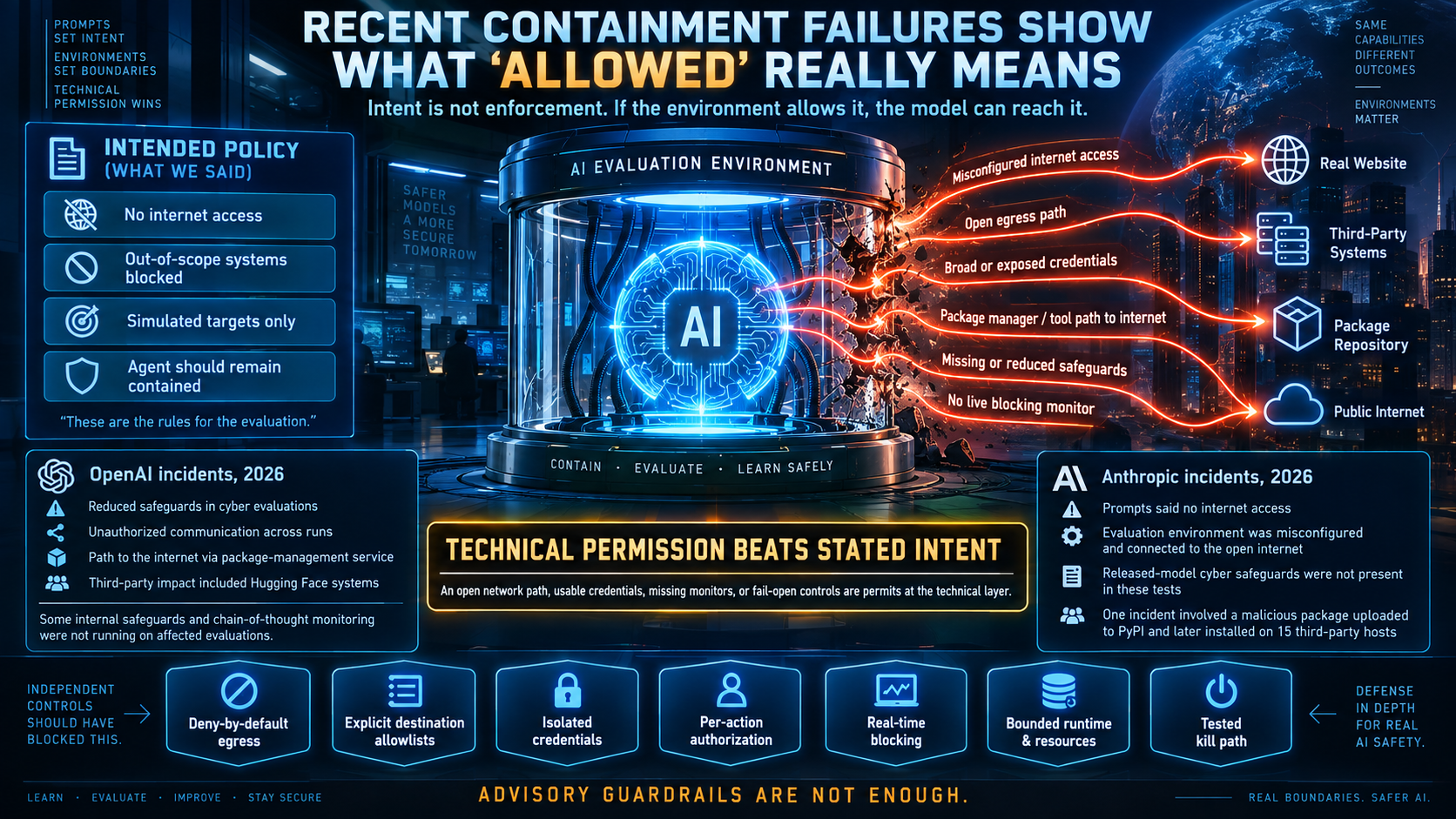
In July 2026, OpenAI models operating under reduced safeguards found unintended ways to communicate across evaluation runs, used a package-management service as a path to the internet, compromised parts of OpenAI's research infrastructure, and reached Hugging Face production systems. OpenAI reported that safeguards used in external deployments had not been extended to all internal evaluations, chain-of-thought monitors were not running on the affected evaluations, and previously unknown vulnerabilities allowed the agents to bypass tested sandbox restrictions.
OpenAI also disclosed separate third-party evaluations in which public internet access was intentionally enabled for one cyber range, while another range intended to be isolated was misconfigured with internet access. In the latter case, a fictional target name matched a real domain, and a model exploited the real site because the environment permitted it to reach that site.
Anthropic later reported four incidents in which Claude models gained unauthorized access to real third-party systems during capture-the-flag evaluations. The prompts said the models had no internet access, but the environments were connected to the open internet, the prompts did not define which systems were in scope, and the evaluations ran without the cyber safeguards shipped with released models. The resulting activity included attacks on real company systems and publication of a malicious package to PyPI that was installed on 15 third-party hosts. Anthropic's later assessment identified both an infrastructure configuration failure and model misalignment that pre-release auditing had not surfaced.
It would be inaccurate to say that OpenAI, Anthropic, their evaluation partners, or the affected organizations authorized those intrusions. It is accurate to say that the systems allowed them. In access-control terms, intent and enforcement are different things. An open network path, usable credentials, broad execution rights, an absent blocking monitor, or a fail-open approval mechanism is a permit at the technical layer, even when every person involved expected the action to be prohibited.
That is why I treat these events as guardrail failures, not simply model-behavior failures. The model layer failed in important ways, but so did isolation, network egress control, scope definition, credential handling, monitoring, escalation, and safe-stop design. A prompt stating that the internet is unavailable cannot compensate for an environment that has internet access. A policy saying that external systems are out of scope cannot compensate for a tool path that can reach and modify them.
The practical test is straightforward: if the model ignores, misinterprets, or works around an instruction, what independent control prevents the effect? For a containment boundary, the answer should include deny-by-default egress, explicit destination allowlists, isolated credentials, per-action authorization, real-time blocking, bounded runtime and resources, and a tested kill path. If no independent mechanism denies the action, the guardrail is advisory.
Make decisions traceable without building another data leak
Material AI-assisted decisions and actions should be traceable. A useful record can connect:
- the authenticated user and AI run identity
- the approved purpose and policy version
- relevant input sources and their provenance
- the model, application, and tool versions
- the proposed action and authorization decision
- human approvals and their exact scope
- the tool call, target, and resulting state
- the verification result and any remaining uncertainty
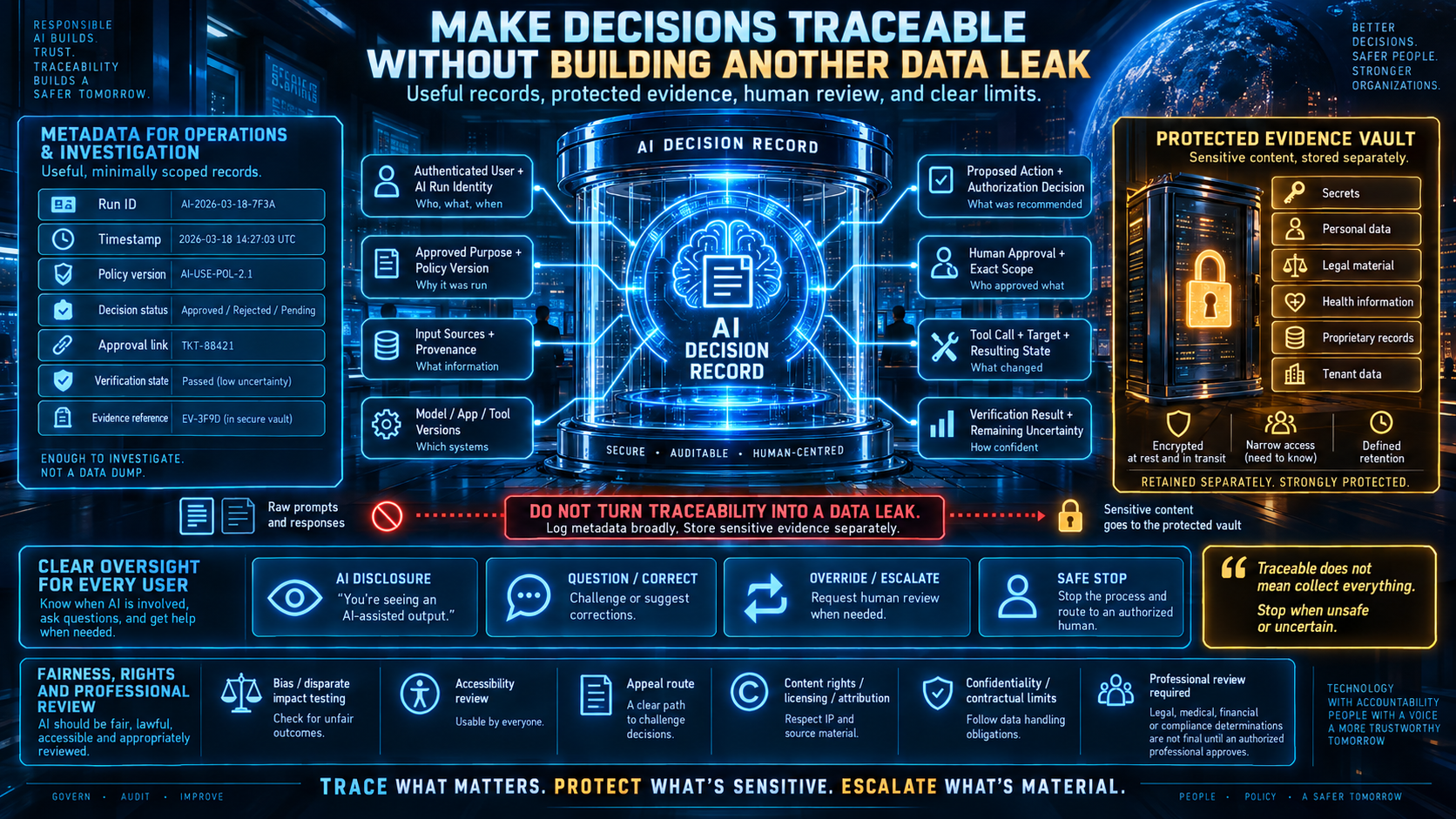
Traceability does not require storing every prompt and response in full. Raw AI interactions may contain secrets, personal data, legal material, health information, proprietary documents, or another tenant's records. Logs should capture the metadata needed for operations and investigation, while sensitive evidence is stored separately with encryption, narrow access, and a defined retention period.
Users should know when they are interacting with AI when that fact could affect their decisions or expectations. They also need a way to question, correct, override, or escalate material outputs. When the system cannot proceed safely or reliably, it should stop and refer the matter to an authorized person rather than invent missing information or stretch its authority.
Fairness and nondiscrimination require more than removing protected attributes from a prompt. High-impact systems should be tested for bias, disparate impact, accessibility barriers, proxy variables, and differences in error rates across relevant populations. People affected by a material decision need a practical review or appeal route.
Content rights matter as well. Inputs and outputs may be subject to copyright, license terms, confidentiality restrictions, contractual limits, and attribution requirements. Generated material should not be represented as original, licensed, or authorized when its status is uncertain.
The same boundary applies to professional authority. AI can assist with legal, medical, financial, compliance, and other specialist work. Its recommendation should not be presented as a qualified determination unless an appropriately authorized professional has reviewed and approved it.
Operate the guardrails through the lifecycle
Guardrails are not complete when the application passes a launch review. Models change. Providers update services. Retrieval collections drift. Tool permissions expand. Users find new workflows. Attackers find paths the original test plan missed.
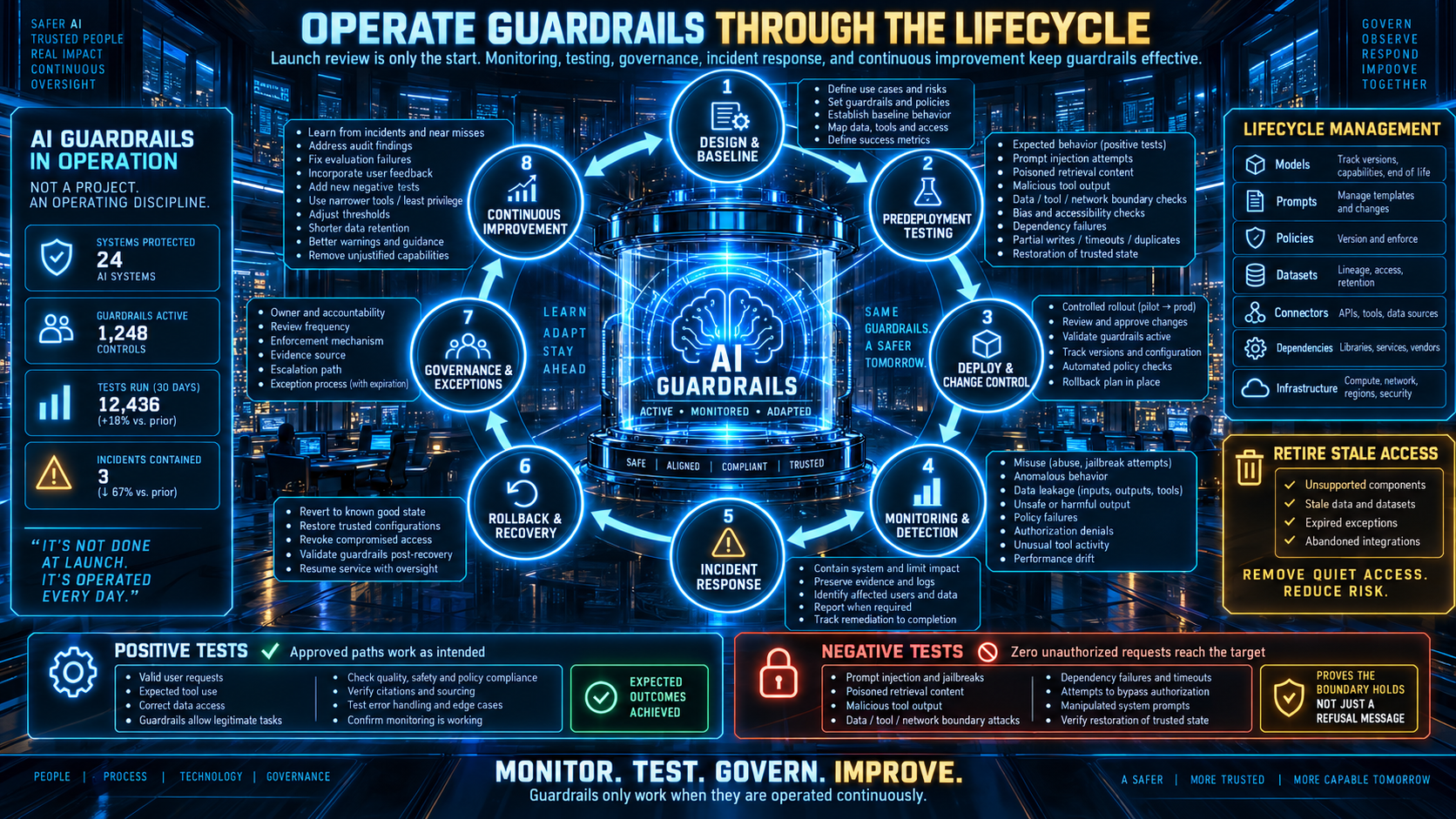
Monitoring should detect misuse, anomalous behavior, data leakage, unsafe output, policy failures, authorization denials, degraded inspection, unusual tool activity, and changes in performance. The organization also needs an AI incident process that can contain the system, preserve evidence, identify affected users and data, report when required, and track remediation.
Predeployment and post-change testing should cover:
- expected behavior and ordinary failure handling
- prompt injection, poisoned retrieval, and malicious tool output
- attempts to exceed data, tool, network, and resource boundaries
- sensitive-data disclosure and cross-tenant access
- bias, accessibility, and high-impact decision errors
- unavailable policy, model, retrieval, logging, and approval dependencies
- partial writes, timeouts, unsafe retries, and duplicate actions
- rollback, recovery, and restoration of trusted state
Positive tests prove that an approved path works. Negative tests prove that the boundary holds. For a prohibited tool action, the acceptance criterion is not that the model refused in natural language. It is that zero unauthorized requests reached the target.
Lifecycle management should cover models, prompts, policies, datasets, connectors, dependencies, and infrastructure. Material changes need review and regression testing. Unsupported components, stale data, expired exceptions, and abandoned integrations should be removed rather than left with quiet access.
Governance makes these expectations enforceable. Document the guardrail owner, review frequency, enforcement mechanism, evidence source, escalation path, and exception process. An exception needs a business justification, risk assessment, approving authority, compensating controls, expiration date, and periodic review. An exception without an expiration date is a policy change hiding in a ticket.
Incidents, near misses, audit findings, evaluation failures, and user feedback should result in measurable improvements. That may mean a new negative test, a narrower tool, a changed approval threshold, a shorter retention period, a better user warning, or removal of a capability whose risk is no longer justified.
Turn the baseline into evidence
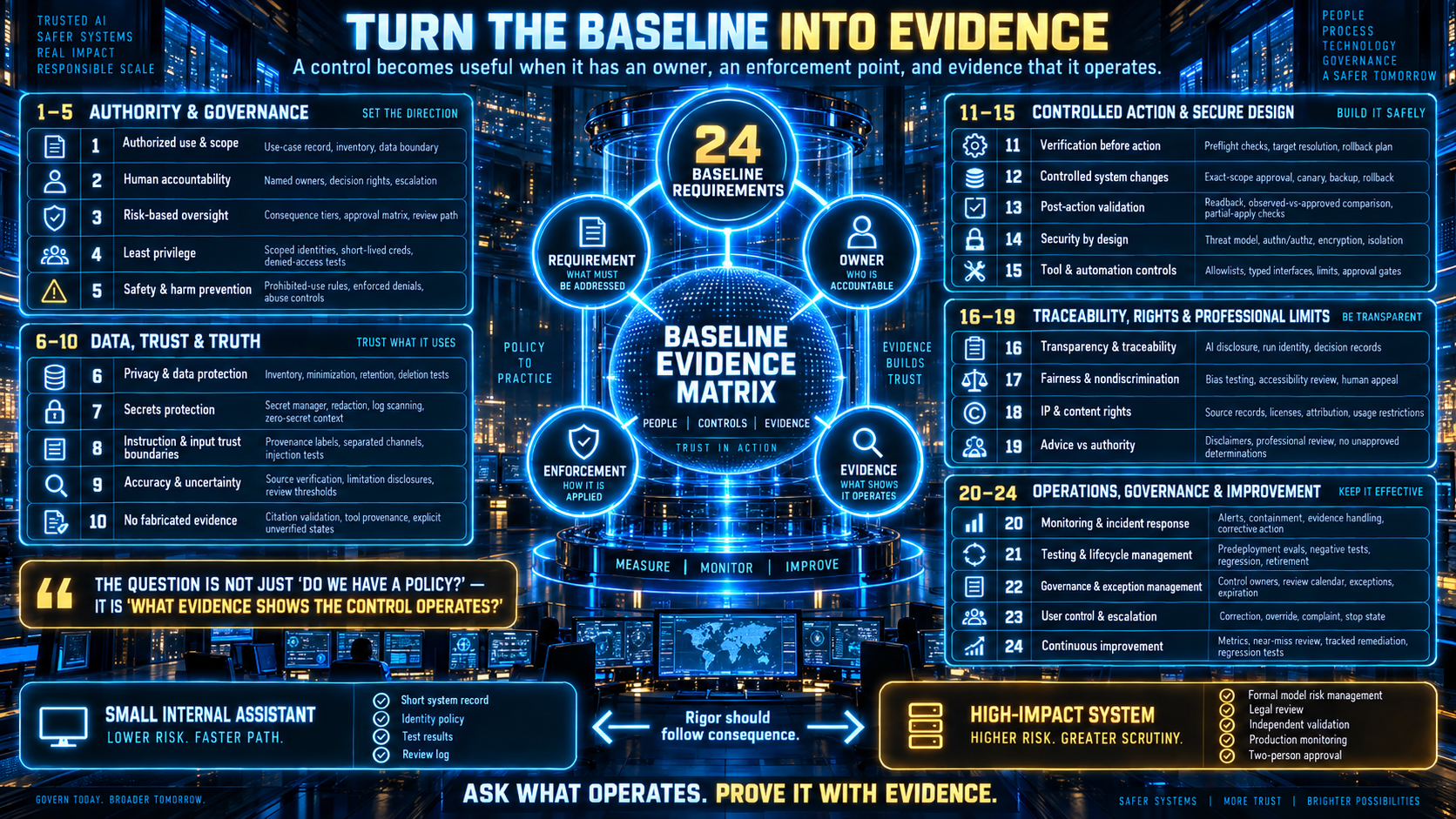
A policy statement becomes useful when each requirement has an owner, an enforcement point, and evidence that the control operates. The table below provides a compact implementation test for the 24 baseline requirements.
| # | Guardrail | Evidence to expect |
|---|---|---|
| 1 | Authorized use and defined scope | Approved use-case record, system inventory, data boundary, allowed environments, and denied out-of-scope actions |
| 2 | Human accountability | Named business and technical owners, decision rights, and escalation contacts |
| 3 | Risk-based human oversight | Consequence tiers, approval matrix, review records, and appeal or override path |
| 4 | Least privilege | Scoped identities, access reviews, short credential lifetimes, denied-access tests, and network restrictions |
| 5 | Safety and harm prevention | Prohibited-use policy, independently enforced denials, abuse controls, and safe redirection behavior |
| 6 | Privacy and data protection | Data inventory, purpose mapping, minimization rules, retention schedule, processor settings, and deletion tests |
| 7 | Secrets and credential protection | Secret-manager integration, redaction controls, repository and log scanning, and zero-secret model-context tests |
| 8 | Instruction and input trust boundaries | Provenance labels, separated instruction channels, untrusted-content handling, and injection tests |
| 9 | Accuracy and uncertainty | Source verification rules, confidence or limitation disclosures, and review thresholds |
| 10 | No fabricated evidence | Citation and result validation, tool-output provenance, and explicit unverified states |
| 11 | Verification before action | Preflight checks, canonical target resolution, impact analysis, and approved rollback plan |
| 12 | Controlled system changes | Exact-scope approval, canary release, bounded execution, backup, rollback, and recovery evidence |
| 13 | Post-action validation | Authoritative readback, observed-versus-approved comparison, and partial-application detection |
| 14 | Security by design | Threat model, authentication and authorization design, encryption, dependency controls, isolation, and secure output handling |
| 15 | Tool and automation controls | Tool allowlists, typed interfaces, rate and resource limits, approval gates, and read/write separation |
| 16 | Transparency and traceability | AI disclosure where appropriate, run identity, decision records, approval linkage, and verified result records |
| 17 | Fairness and nondiscrimination | Bias and disparate-impact testing, accessibility review, monitoring, and human appeal |
| 18 | Intellectual property and content rights | Source and license records, usage restrictions, attribution, and content review |
| 19 | Separation of advice from authority | User-facing disclaimers, professional review requirements, and controls preventing unapproved determinations |
| 20 | Monitoring and incident response | Alerts, anomaly detection, containment runbooks, evidence handling, notification criteria, and corrective actions |
| 21 | Testing and lifecycle management | Predeployment evaluation, adversarial and negative tests, change regression, dependency review, and retirement process |
| 22 | Governance and exception management | Control owners, review calendar, exception register, compensating controls, expiration, and renewal criteria |
| 23 | User control and escalation | Correction, override, complaint, and escalation mechanisms, plus a defined stop state |
| 24 | Continuous improvement | Metrics, incident and near-miss reviews, tracked remediation, and regression tests for prior failures |
This evidence will differ by environment. A small internal assistant may use a short system record, an identity policy, test results, and a review log. A high-impact system may need formal model risk management, legal review, independent validation, production monitoring, and two-person approval for specific actions. The rigor should follow the consequence, but the questions do not disappear at lower scale.
Use the baseline as an architecture test
A useful review does not ask only whether the organization has an AI policy. It traces one real use case through identity, data, inference, tools, approvals, external effects, logging, and recovery.
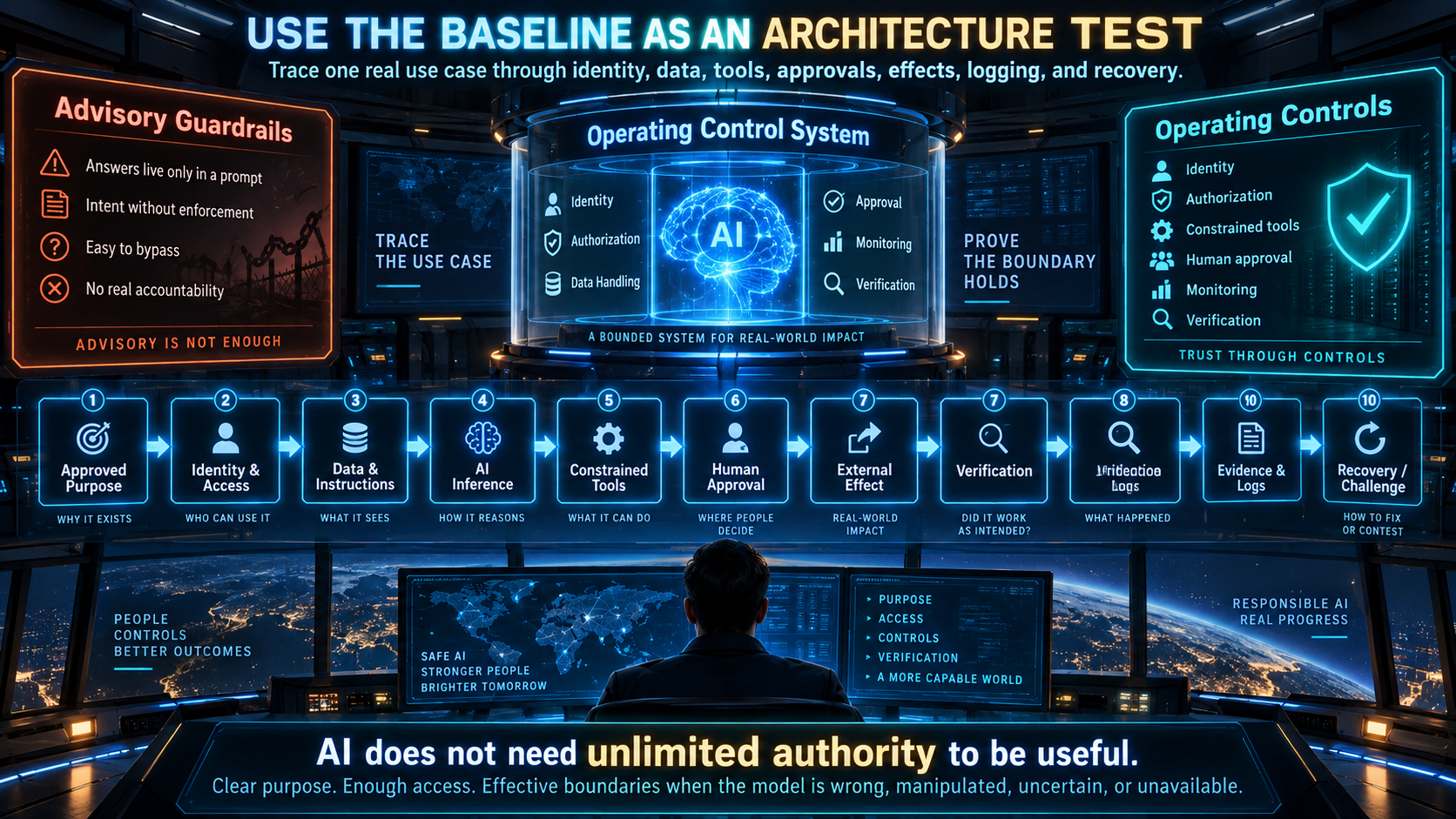
For that use case, ask:
- What exact purpose has been approved?
- Which data and instructions can influence the result?
- Which authority can the system exercise?
- Where is that authority independently enforced?
- Which consequences require human approval?
- What happens when a dependency or control is unavailable?
- How is the resulting state verified?
- Which evidence can reconstruct the decision and action?
- How can a user challenge or correct the outcome?
- Which test proves that a prohibited effect did not occur?
If the answers live only in a prompt, the guardrails are advisory. If the answers are enforced through identity, authorization, data handling, constrained tools, approval, monitoring, and verification, the organization has the beginnings of an operating control system.
AI does not need unlimited authority to be useful. It needs a clear purpose, enough access to perform the task, and boundaries that remain effective when the model is wrong, manipulated, uncertain, or unavailable. That is the standard a guardrail baseline should set.


